-1.png?width=150&height=31&name=logotipo_centro_de_ayuda%20(1)-1.png)
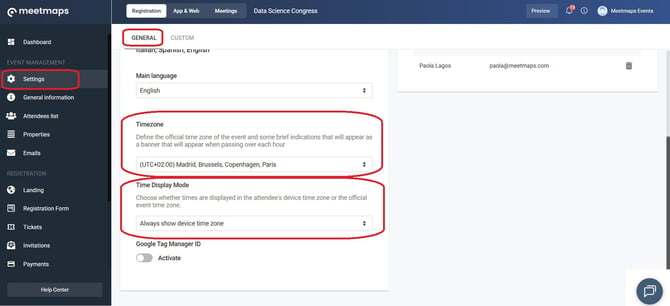
By defining the official time zone for your event, the platform will understand that all times entered on the dashboard correspond to that time zone.
By default, when an attendee accesses the App, Website, or Landing, the event times are automatically adjusted to the time zone of each attendee's device. This way, the attendee always sees the agenda or 1-to-1 Meetings adapted to their local time, provided their device is set to the correct location and time.
If the organizer prefers, it's also possible to set the event time zone so that it doesn't adjust and all attendees always see the same times, regardless of their location.
Define the settings in the Settings > General section.
Choose one of the two time display options:
-
Always show device time zone
-
Always show event time zone
IMPORTANT❗: Regardless of the attendee's location, push notifications and campaigns are sent exactly at the time scheduled in the dashboard, using the event's official configured time zone.
Examples: Device time zone (Attendee's location)
Online or live-streamed events
If you are organizing an online conference with international speakers and attendees, it is best to keep automatic adaptation enabled. This way, session times are displayed based on each user's device settings, allowing every participant to know the exact local time to join the live session without having to calculate time differences manually.
Example 1
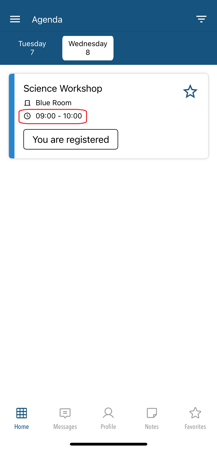
An agenda session that starts at 9:00 AM in an event configured for (UTC+01:00) Madrid, Brussels, Copenhagen, Paris:
-
The attendee located in Madrid will see the start time of 9:00h:
-
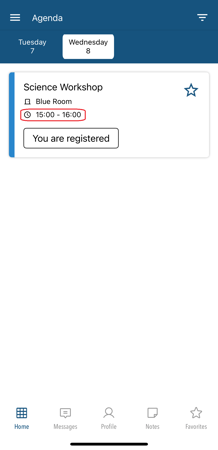
Attendees located in New York will see the start time of this session at 15:00h (UTC-04:00) Eastern Time (US & Canada), Indiana.
Example 2
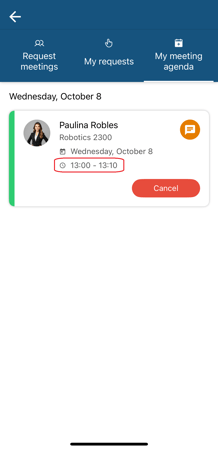
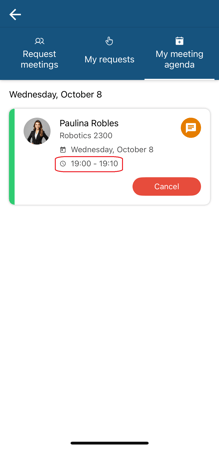
A Meetings1to1 session between attendees will begin at 13:00h (UTC+1).
-
Attendees in Madrid will see the start time set to 13:00h
-
The attendee who is in New York will see that the start would be at 19:00h (UTC-04:00) Eastern Time (US & Canada), Indiana since that is their local time at that moment.
Examples: Fixed time zone of the event
100% in-person events or events with travel
If you're organizing a physical congress, trade fair, or convention, it's advisable to set the time zone to the event location. This way, the times are always displayed according to the venue's time, and attendees can clearly plan their schedules and travel, regardless of the app they're using before traveling.
An agenda session starting at 9:00h at an event set to (UTC+01:00) Madrid, Brussels, Copenhagen, Paris:
-
The attendee located in Madrid will see the start time of 9:00h:
-
Attendees located in New York (UTC-04:00) Eastern Time (US & Canada), Indiana, will see the start time of this session at the same time.
Example 2
A Meetings1to1 session between attendees starts at 13:00h (UTC+1).
-
The attendee located in Madrid will see the start time as 13:00h.
-
The attendee who is in New York will see that the start time is also 13:00.
NOTE 🗒️:
- For this feature to be effective, attendees must have the time zone correctly configured on their device and browser, as this is the information that the system uses to make the necessary adjustments.
- We recommend that if the administrator of the dashboard is in a different time zone than the official event time zone, test as if you were an attendee, changing the time zone of the device from which you are consulting it